
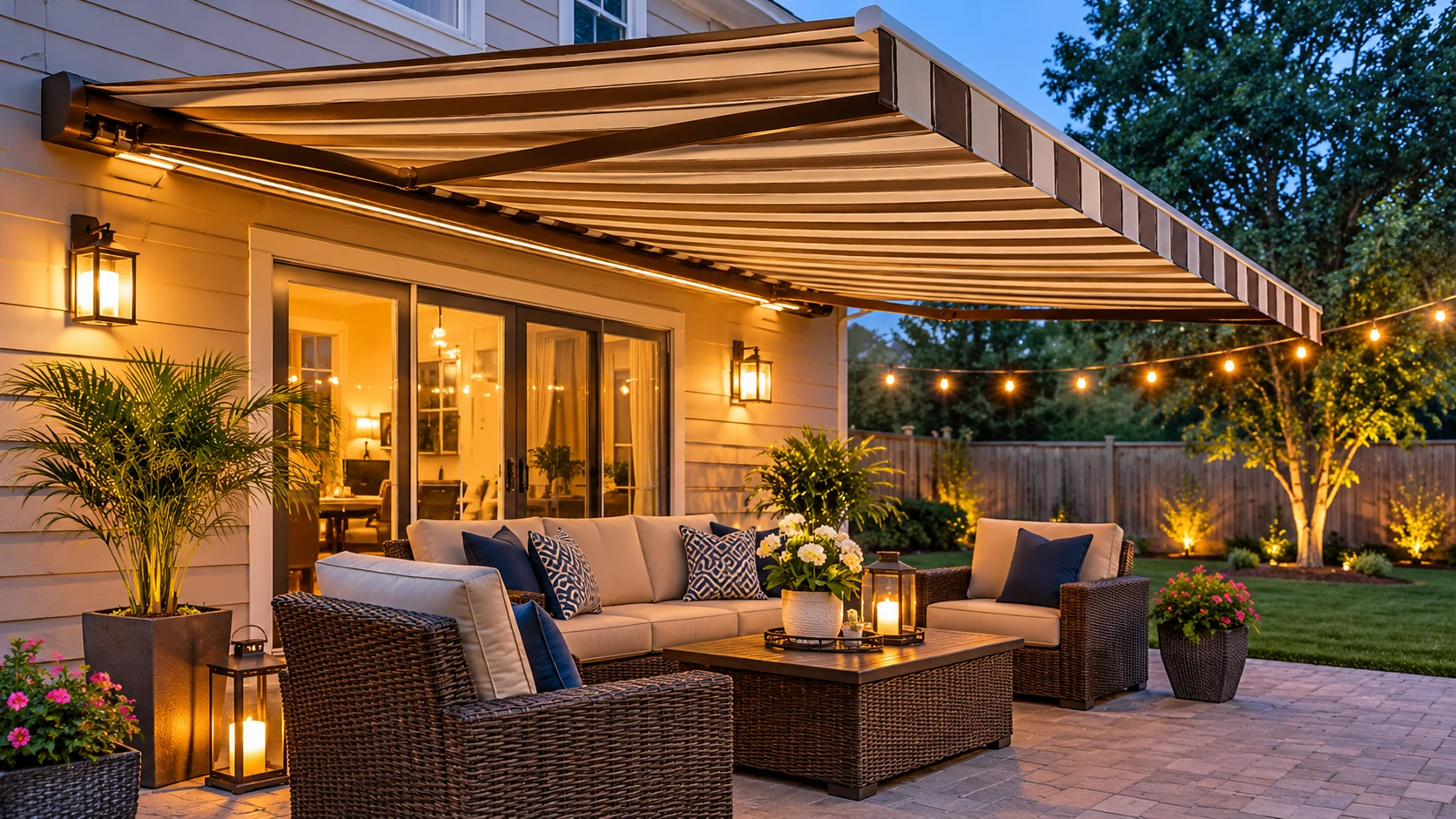
Anyone who has tried to eat dinner on a Lake Charles patio in July knows the problem. The afternoon sun is relentless, the humidity hangs on you, and a thunderstorm can show up before the food reaches the table. A retractable awning can fix a lot of that, but only if the one you choose fits your house, your patio, and the way you actually use the space.
Awnings are not all built the same, and the differences matter more on the Gulf Coast than in milder climates. This guide covers how to choose a retractable awning for your Lake Charles patio, what to look at, and which questions to ask before you sign anything.
Start With How You Use the Patio
Before you look at a single fabric swatch, think about when and how your patio gets used. A patio where you grill and eat dinner at 6 p.m. has different needs than a back porch where you drink coffee at 7 a.m.
Pay attention to where the sun hits. West and south facing patios take the harshest afternoon sun, and that is usually when the heat is at its worst. If your patio gets sun from late morning straight through the evening, you will want more coverage than a patio that is shaded by a tree or the house itself for half the day.
Also think about what you are protecting. Sun does not just make you uncomfortable. It fades cushions, rugs, and outdoor furniture, and it can warm the windows and doors that open onto the patio. A good awning handles all of those problems, so a clear picture of your priorities makes every other decision easier.
Get the Width and Projection Right
Two measurements drive everything else: how wide the awning is and how far it projects out from the house.
Width should cover the area where you actually sit, with a little extra on each side, since the sun angle shifts through the day. Projection is the part people underestimate. An awning that only reaches a few feet past the wall might shade the doorway but leave your table in the sun by late afternoon, when the sun is lower and comes in at an angle.
This is one of the reasons an on-site measurement matters more than an online size chart. Your installer should measure the space, look at where you sit, and show you options. Shade & Storm describes its process as measuring your space and then letting you choose the style, color, and features, which is how it should work. If someone quotes you a size without seeing the patio, be cautious.
Check What the Awning Will Mount To
A retractable awning pulls on the structure it is attached to every time it extends, and wind adds load on top of that. Most retractable awnings can be mounted to wood, brick, masonry, stucco, and many types of siding, but the surface is only part of the story. What matters is whether the awning is anchored into solid framing behind it.
Homes around Lake Charles vary a lot. Older houses, newer builds, brick veneer, and covered porches all handle mounting differently. Some installations attach to the wall, some to the fascia, and some to the rafters of an existing covered area. Ask the installer exactly where the awning will be anchored and why. A reliable installer will inspect the attachment point instead of guessing.
Choose Fabric That Can Handle Louisiana Weather
Fabric is the part of the awning you will look at every day, and it takes the most abuse from sun and moisture.
Sunbrella is one of the best known names in awning fabric, and Shade & Storm uses it on its SunPro awnings. Sunbrella shade fabrics are marketed as UV resistant, fade resistant, water repellent, mildew resistant, and stain resistant. In a humid climate like Southwest Louisiana, the mildew resistance deserves as much attention as the fade resistance. SunPro awnings are offered in 30 in-stock Sunbrella fabrics across five color groups, so there is real choice in color and pattern.
Color affects more than looks. Darker fabrics tend to absorb more heat than lighter ones, and the color of the underside is what you will see from inside your home and from your seat on the patio. Pick something you will be happy with from both views, and ask to see physical samples in your own light instead of choosing from a screen.
Even good fabric needs basic care. Regular gentle cleaning keeps dirt and pollen from setting in, and it delays the need for deep cleaning later.
Look for a Cassette Housing
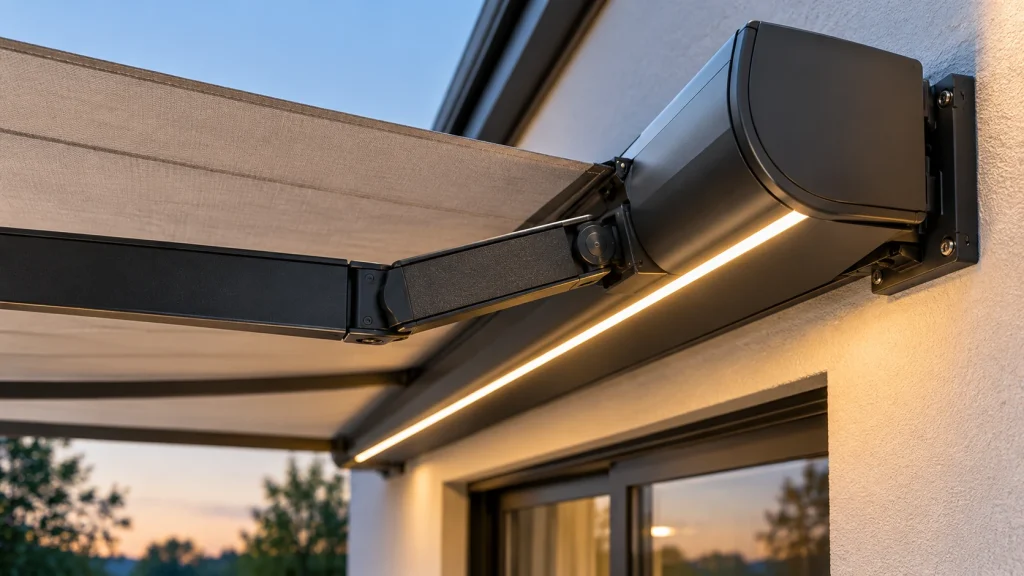
If you take one feature seriously, make it the cassette. A cassette housing is a protective case that closes around the fabric when the awning is retracted. It keeps rain, insects, birds, dust, and sun off the fabric while it is stored.
That matters here because a retractable awning spends most of its life rolled up. Without a housing, the fabric sits exposed to the same sun, rain, and humidity you are trying to escape. SunPro awnings include an integrated cassette housing, and it is one of the features Shade & Storm highlights on its awnings.
While you are looking at the hardware, ask about the frame and fasteners too. Coastal humidity is hard on metal, so you want to know what the frame is made of, how it is finished, and how the hardware holds up over time.
Decide How You Want to Operate It
Most buyers want the push-button convenience of a motorized awning, and for good reason. An awning you can extend in seconds gets used far more than one you have to crank by hand.
Two things are worth asking about. The first is a manual override. SunPro awnings are motorized with a wireless remote and include a manual override, which matters in a region where storms can knock out power. If the awning is extended when the power goes out, you want a way to bring it in.
The second is sensors. Some systems can be paired with wind or sun sensors that retract or extend the awning automatically. Availability depends on the system and the installer, so ask directly whether sensors are an option for your awning and what they cost. In a place where afternoon storms can move in quickly, an automatic response is a real convenience, as long as you do not treat it as a substitute for paying attention to the forecast.
Think About Pitch and Lighting
Two smaller features make a bigger difference than most people expect.
Pitch is the angle of the awning. A steeper pitch blocks lower sun and helps water run off instead of pooling on the fabric. A shallower pitch gives more headroom and a more open feel. Adjusting pitch used to mean calling a technician, but SunPro’s EZ-Pitch adjustment is designed to make that change simple, and it is standard on SunPro awnings. In practice, that means you can adjust the angle through the seasons and as the sun moves.
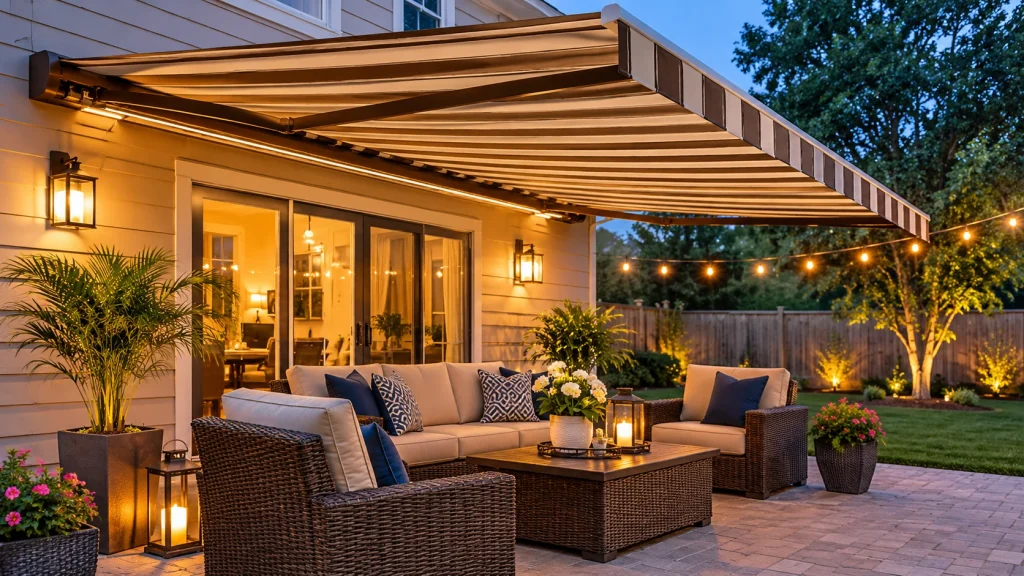
Lighting is the other. Shade & Storm’s SunPro awnings include integrated LED lighting, and the SunPro system describes dimmable lights built into the arms and controlled by remote. In Southwest Louisiana, plenty of people wait until after sundown to enjoy the patio because the daytime heat is too much. Built-in lighting turns the awning into part of the evening space instead of just a daytime shade.
Be Realistic About Wind, Rain, and Hurricane Season
This is the part that gets glossed over, so here it is plainly. A retractable awning is shade equipment. It is not storm protection.
Retract the awning when the wind picks up, when a storm is approaching, and before any tropical weather. Pitch it so water runs off instead of collecting, and bring it in when rain turns heavy. An awning is a good partner for a patio in a place with sudden thunderstorms, but it should be retracted, not left to ride them out.
If protecting the house during hurricane season is a priority, that is a separate job. Shade & Storm also installs hurricane protection, and it makes more sense to plan shade and storm protection together than to expect one product to do both.
Compare Awnings With Motorized Screens
Awnings shade from above. Motorized screens cover the vertical openings, so they block low angle sun, insects, and wind, and they give you privacy.
Many Lake Charles patios deal with several problems at once: overhead sun, glare from a western exposure, and mosquitoes at dusk. An awning handles the first well, and a screen handles the others. Some homeowners choose one, and some pair them. If bugs are your biggest complaint, look at motorized screens before deciding that an awning alone is the answer.
Choose an Installer and Warranty You Can Count On
A good product installed poorly will not last. The installer matters as much as the awning.
Ask who actually does the installation, whether they measure on site, and who services the awning afterward. A locally owned company based in Lake Charles is easier to reach when something needs adjusting than a national seller shipping you a box. Shade & Storm is locally owned and operated, serves homeowners across Southwest Louisiana and Southeast Texas, and says its team brings many years of experience in the region.
Then look at the warranty. Shade & Storm lists a 10 year non-prorated warranty. Non-prorated means the coverage does not shrink as the awning ages, which is better than a warranty that pays less each year. Whichever company you consider, ask exactly what the warranty covers, whether that includes the frame, fabric, and motor, and get the terms in writing.
A Checklist to Take Into Your Estimate
Before you meet with any installer, bring these questions:
- Will you measure the patio in person before quoting?
- How wide will the awning be, and how far will it project?
- What will it mount to, and have you checked the framing?
- What fabric does it use, and can I see samples?
- Does it have a cassette housing?
- Is there a manual override if the power goes out?
- Are wind or sun sensors available?
- What does the warranty cover, and is it prorated?
- Who installs it, and who services it afterward?
Common Questions About Retractable Awnings in Lake Charles
Do retractable awnings work in Louisiana humidity?
Yes, if the fabric and hardware are chosen for it. Look for a mildew resistant fabric such as Sunbrella, a cassette housing to protect the fabric when retracted, and a frame and hardware that handle moisture.
Can I leave a retractable awning out during a storm?
No. Retract it when wind picks up or a storm is coming. It is built for shade, not for storm protection.
How do I know what size I need?
It depends on where you sit and where the sun hits, so the best answer comes from an on-site measurement. A free estimate is the easiest way to get one.
If you’re ready to see what a retractable awning could do for your patio, check out our retractable awnings page to see the SunPro options we install, including Sunbrella fabrics, integrated LED lighting, and cassette housing. Or call us at (337) 552-2002 to schedule your free estimate. We’ll measure your space, walk you through your options, and help you choose an awning that fits your patio and your Louisiana weather.
